Carlos Rodero is a researcher at the Institute of Marine Sciences - CSIC (ICM-CSIC) with expertise in marine optics, low-cost sensors and citizen science. Within AMRIT, CSIC leads WP15 (“Improvement of Global Data Products from Blended EOVs”), focusing on the data-fusion methods for ocean colour, temperature, and oxygen for offshore and coastal datasets (including biodiversity in the latter case).
What is data fusion, and how can it help marine science?
Marine research infrastructures collect a vast array of ocean observations, from satellite imagery and autonomous floats to fixed stations and sensors -offshore and along the coast. This diversity is both a strength and a challenge. Marine scientists often face fragmented datasets that are difficult to integrate. Data fusion addresses this by combining multi-source ocean observations into coherent, synergistic data products about Essential Ocean Variables.
What exactly are Essential Ocean Variables (EOVs), and why are they important?
EOVs are key oceanographic parameters identified by the Global Ocean Observing System (GOOS) to guide and prioritize monitoring efforts. They include physical variables like temperature, biogeochemical variables such as oxygen, and biological variables, for example plankton. EOVs help link scientific monitoring to societal needs; for example, sustained measurements of temperature and oxygen are critical for assessing climate change and the health of marine ecosystem.
How does data fusion enhance EOVs?
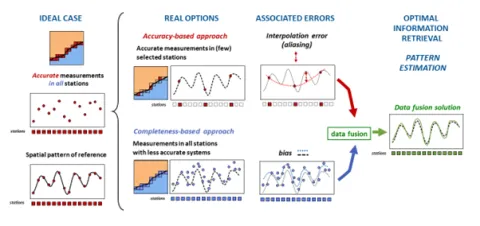
By merging datasets, we can create blended EOVs that provide a more complete picture of reality than any single source. For example, in the case of ocean colour: a few stations equipped with reference-quality sensors supply reliable chlorophyll/optics data, but they are sparse; many other stations offer dense coverage yet may have biases. In the fusion, the reference sites establish the scale (adjusting for bias), while the wider network fills in the gaps and captures detailed coastal patterns—so the combined view reflects what is really happening much more closely (see figure 1).
How is AMRIT addressing these challenges?
First, we aim to develop a “data pathway of blended EOVs.” This involves identifying and harmonizing relevant datasets -both coastal and offshore-, which will then be used by project partners to implement and compare data fusion techniques. The plan also recognises citizen-science contributions in near-shore areas, pairing them with reference stations. The result will be multi-source datasets and guidelines that support robust data fusion workflows.
What is the expected outcome of AMRIT’s data fusion work?
This work supports AMRIT’s broader mission to integrate marine research infrastructures and deliver improved, blended EOV products to stakeholders. It aligns with global ocean observing strategies and helps ensure that marine data can effectively inform science, policy, and society.